When we think we already know someone,
We stop making an effort to know them better.
When we do not know someone,
We make an effort to get to know them.
Love is the state of not knowing,
And of wanting to know more.
Consider whether you think you already know
Your loved ones.
If you do, you are failing to see them as they are right now
And seeing them instead through the prism
Of previously held opinions.
- Haemin Sunim
So I've decided to split this post into two parts, because there's just too much to be said!! This first part will focus mainly on receptivity with regards to the body - eating and moving. The next part will probably be about receptivity in other aspects of life, like meditation, relationships, etc (I haven't written it up in advance so it could take its own unexpected shape haha).
I know it's a bit random to be talking about this topic right now, but I actually began this post some months ago and since the world has been shut down from corona, I thought, why not get writing.
I think it was in 2017 that I began to tune into this idea that there are needs and wants - two different things.
I mean, it sounds so obvious.
What I need is food and shelter. What I want is a partner who physically resembles Yuki Furukawa with the classiness of Benedict Cumberbatch.
🤷
But I think it isn't always that obvious. I think at some point we stop tuning in to what we need and simply start responding to what we want (or if we wanna unravel that further: what we are told to want). Maybe because that sensation of wanting is stronger. More enticing, more pushy, and so, more deluding.
What we need seems to be more subtle, so I think knowing what that is requires lots of space, listening and receptivity.
I love this word "receptivity". It's essentially mindfulness, but I resonate with it more because it sounds less like something you have to "do" (which is not what mindfulness is per se, but I think for me that word has been so butchered and has been given so many deluding connotations that it has come to take on an overly active definition instead of a relatively passive one). Receptivity is just receiving. It's just a kind of tuning in.
Learning about this within the body has been quite a huge lesson to me, and I think without realising, learning this lesson with regards to things as basic as food and exercise has changed my life tremendously, helping me to relate receptivity as a way of being to other aspects of my life as well (which I will try to talk more about in the next post).
Stage 1: Deprivation
My body did not have a good time from ages 15 to 21; I wasn't treating it very well. In highschool, I started being super obsessive about body image, fuelled by everyone's favourites: insecurity, comparison and self-consciousness. I started dieting and exercising like a mad person, imposing an oppressive regime onto my body. It wasn't even about health, it was purely to look good (or not look bad - that's how bad my self-esteem was at the time). Needless to say, the motivation was not great and I wasn't appropriately responding to the individual needs of my body at all.
Essentially, I wasn't listening to my body. I was completely out of tune with it. The way I operated was just eat x (some unrealistic) amount of calories and exercise y amount of hours per week to reach z kg, whether or not that felt good or right. If we're being real, I was probably bordering on anorexia. I followed a diet that involved calorie-restriction on the weekdays, with maybe one or two cheat days on the weekend. My body was so impoverished on the weekdays that when it came to cheat meals, I would mindlessly binge, like to the point where I wasn't even enjoying the food I was eating anymore, I was just pushed to eat whatever simply because they were usually off-limits but not today.
The exercise I was doing was a complete chore. My brother and I played lots of tennis in those days, and we had extra training sessions with a PT specifically dedicated to building fitness. So I was doing something like three two-hour sessions of tennis and two one-hour sessions of fitness a week. Fitness involved going to the gym (I hate the gym), doing stuff on the treadmill, HIIT, weights, just ughhghishdg. Look, it was just willpower fuelling this stuff. No enjoyment whatsoever.
Anyway, I did reach my goal somewhat - I was at a good level of fitness, but although I was somewhat satisfied with my appearance I was still extremely fixated on losing even more weight because, let's be real, no matter how good I looked it would never be enough for me. It was the typical thing of seeing all these models who look good online and wanting to force my body into being like that, even though it might not have been physically possible since every body is different, and even if it was possible, it probably wasn't healthy at all.
Most of all, I didn't feel well. It definitely was not sustainable. And mentally, I was on fire.
Stage 2: Apathy
When I was around 17, I started having a quarter-life crisis. At this point, I was probably mentally exhausted and deeply unhappy from all the insane body-shaming from myself (and others), extreme dieting and exercise, and overwhelming insecurity. Overall, I was just in a really negative mental space and started searching for meaning. At that time, veganism appealed as an avenue for exercising compassion and doing something for the greater good. It was the beginning of the idea that I could do something to change the way I live my life to make the world a little better. So I went vegan overnight after watching the documentary 'Earthlings'.
Motivation was better, but effort was still not right. I didn't do research on how to do it effectively, especially in terms of how to stay healthy. My understanding of health was not holistic at the time and to be honest, I really didn't care - my previous lifestyle was born out of insecurity and vanity anyway, so it was never really about well-being to begin with. After a while, I probably told myself some kind of narrative of like, if I was vegan I could pretty much eat whatever I wanted within the bounds of the diet because I was already doing something wholesome. Which I guess is good in a sense, but you can go completely south with that and eat Lord of the Fries everyday.
Anyway, at least now the motivation was to prevent animal cruelty, so it was slightly better. But of course, knowing me, I was hardcore about it and started being that vegan that shoves their views down everyone's throats (friends I'm so sorry if you had to interact with that side of me). And going vegan naturally led me to Buddhism as well, since compassion is a big part of the teaching, so I also started getting into it and being hardcore about that too. I wrongly grasped the teaching on letting go of conventional reality and then very mistakenly started living with the mentality of "who cares about anything, let it all go and just get enlightened" which, looking back, is so funny (this is like a whole other saga, which explains why I've been so neurotic about everything these past few years and when I started this blog I think I had started recovering from that mindset, but we can talk about this another time). I eventually ate whatever I liked (as long as vegan) and stopped exercising regularly. Since I never genuinely enjoyed the way I was eating and the exercise I was doing, it was almost inevitable that this happened as a result - I was so burnt out from forcing myself to do things.
I started gaining weight, I did not look good. I also didn't feel very good physically, I got sick a lot and felt super weak. But not being crazy about calories and not tyrannically making myself exercise was probably such an overwhelming relief that I didn't care too much at first.

But then I was still self-conscious about my body, and you know, Asian relatives are brutal and will just openly criticise your appearance to your face, so I was still not in a good place about all that mentally. I didn't feel good within myself.
Anyway, Stages 1 and 2 are a classic case of not going the middle way - I swerved from one extreme (holding too tightly to ideals) to another (not caring at all). Both involved stubbornly clinging to some kind of view, which was wrong because I was totally harming myself and being a dickhead to those around me in the process.
Stage 3.1: Good friends to the rescue
Moving to Melbourne was the beginning of the end of this madness. I met friends like Damian, Ash, and Angie, and let me tell you, they healed my troubled, battered soul, man.
 |
| Ash (left) and Damo (right). I owe them my sanity. |

Above everything, I think what helped me most was their complete acceptance of me. They never once made negative comments about my appearance, never told me how I should be eating, never set out to make me feel judged - and that's not just because they were being poite. You can feel when people are just being polite. But our relationship went beyond superficials like that. Everything was metta, I felt so safe.
Actually, come to think of it, the culture in Melbourne is generally like that. People genuinely try not to be judgemental (and even if it's just a superficial thing, it's better than doing the opposite) and they're always just rooting for you, instead of imposing limits on you telling you what you're not capable of.
So at this stage in my life, there was a lot more ease and space. Something KahHoe said recently that I love is "for things to happen, you need space". It's true. Instead of trying to eat and move in a way that fit the ideals of the people around me or of my own, I now had space to explore what would genuinely make me feel good, and perhaps most importantly, the space to make mistakes and just be the way that I was.
It's interesting because space seems like nothing. I guess in a way it is a kind of nothing. It sounds like no one is actively doing anything to help, which is counterintuitive to what we usually think of as 'helping'. But sometimes that non-doing is what you need from your friends, and ends up being the most helpful thing.
On top of giving me space and love, my friends didn't do anything overly special for me. It was mostly by looking at how happy and at ease they were with the way they lived that made me want to explore.
Stage 3.2: Discovering receptivity
Coming out of these old tendencies took years, it was a really gradual process, with lots of disappointing moments. But I guess sometimes the suffering is so real and incessant that the only way is out.
Actually, I feel like I'm still in the process, I'm still learning about it, although I've passed the peak of suffering haha. It's like rehab man, it takes ages.
Damian was the main example that I took in changing the way I ate and moved.
These days we hear of things like 'intuitive eating'. A line taken from this article I randomly found on Google seems to summarise it:
"Intuitive eating posits that the very best diet is no diet at all. Instead of strict food rules, we should tune into our natural-born urges to eat what we want, when we want."
I don't know very much about the nitty-gritties of intuitive eating at all, but the general idea sounds like what Damo was doing. With both exercise and food, he seemed to have a very different approach to the rest of the world. Instead of tyrannically imposing some set of rules on his body to meet a certain goal like weight loss or fitness or vanity, he ate and moved according to what he felt his body needed. "Felt" and "needed" being important keywords here as they point to the quality of receptivity.
It's a very different relationship because now, instead of telling your body what you want it to be and do, you are listening to it and working with it. It's almost like befriending your body. It sounds a bit cliché, but that's the kind of mindset.
This goes beyond cultural conventions, such as needing to eat 3 times a day (newsflash: this is a cultural convention), or going low-carb or doing the Atkinsons diet or fasting because it induces ketosis which is scientifically proven to blablabalba etc. There's no need to keep thinking of the science of nutrition, it's just tuning in to what truly will nourish the body right now, according to its needs right now.
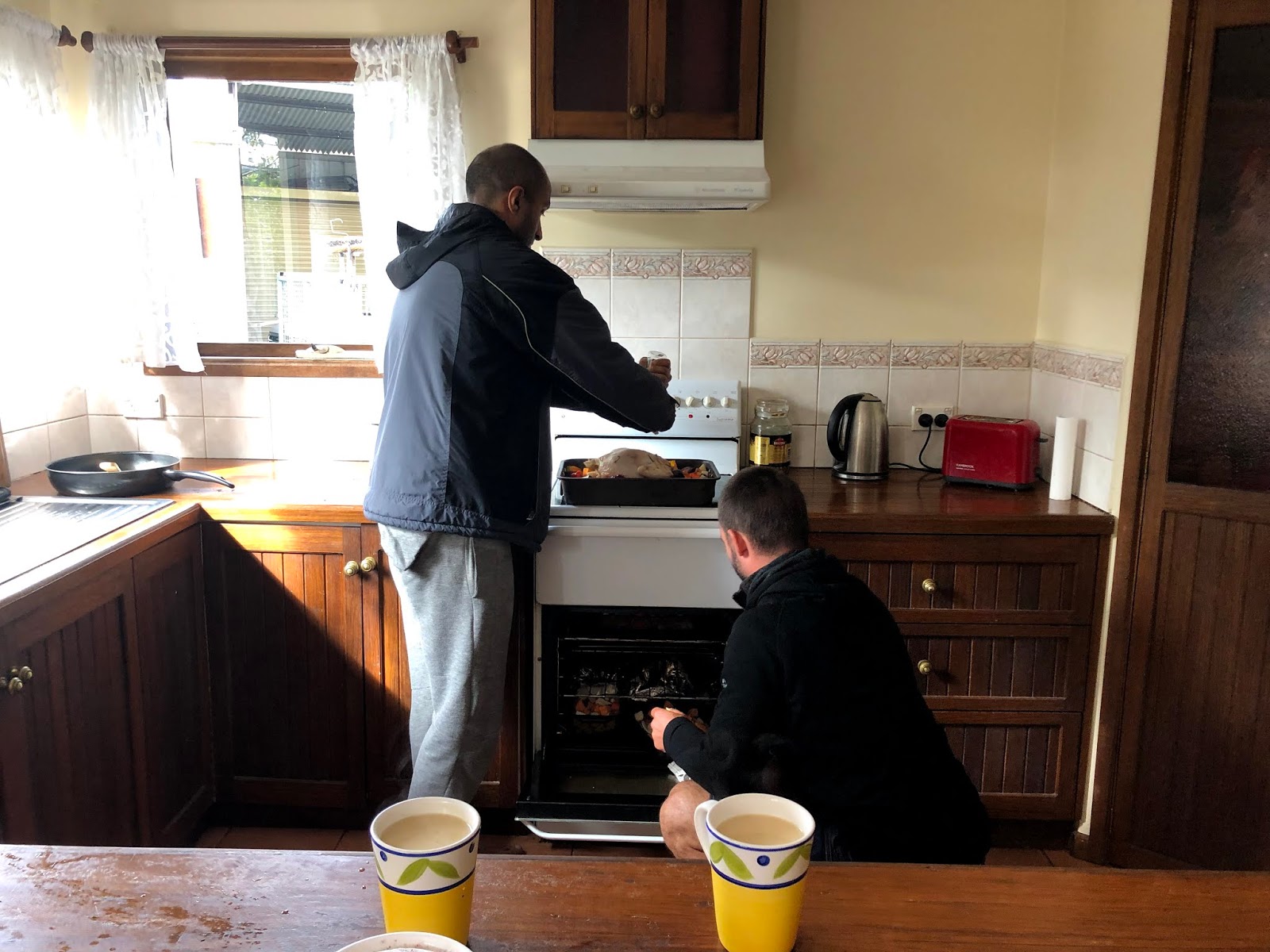
Instead of eating three meals a day, Damo seemed to eat only when he felt the body needed food, whether out of hunger or low energy levels, which if you're being real, is the body's natural indication that it needs food. And then the type of food he was eating was very whole, natural. No processed stuff, not because you're taught to think that it's 'bad' for you but because you know for yourself that you genuinely feel like crap when you do eat it compared to when you're eating whole and homecooked, where you feel nourished and not icky.
He also seemed to do this with exercise. Damo used to play lots of sport - coming from a family of professional athletes, he did AFL, tennis, cycling, etc. He nearly did professional AFL. But all this sport was damaging to his body. So over time he learned to listen. Now he does taichi and big walks, which I think has been a lot more gentle.
I think what impacted me most from observing him was just how natural it all was. Compared to people around me who seemed to have fixed guidelines for food and exercise, and operated with shoulds and should nots in their heads, Damo didn't seem to be limiting himself in anyway - just responding to his changing needs. It was so fluid and relaxed, and I think for someone who has always been restrictive and authoritarian on themselves, this really appealed to me.
I mean, this stuff sounds very commonsensical, very simple - do everything in moderation and don't overdo. But I think we've grown up with so much information from parents, books, friends, media, etc. about what's good for what and what's not good, that we no longer know for ourselves intuitively what is actually good or not. The way I see it, it's very cerebral, not receptive. It's law and order, mechanical, clinical. Like I don't think it's uncommon for people to have the idea that they absolutely need to exercise at least 4 days a week with a certain amount of intensity, otherwise they're gonna lose their fitness. It's not that this is a bad habit, but if you look at the intention behind this (fear of weight gain, fear of health problems, vanity?) and what it does to the mind - it's a very tense, forceful kind of mentality. It's not relaxed. So the result of acting from this kind of space cannot be peaceful either.
I think treating the body in an intuitive way is much easier and more sustainable if we're looking to upkeep physical health and wellness. Rather than giving yourself rules, you eat and move out of intrinsic motivation that comes from self-awareness and understanding of the needs of the body. And because of that, there is no need to force yourself, and because you are not forcing yourself, there is ease and genuine pleasure.
Now I guess the question is, how do you know you're not just being lazy and following your own moods and likes and dislikes?
This is where the distinction between needs and wants comes in. I would like to suggest that as intuitive beings with awareness as a faculty, we know the difference. We know whether we want to eat out of pure craving or whether we're eating because the body needs to. I think it just takes listening in.
Not saying there's anything wrong with indulgence - but from experience, eating out of pure craving makes me feel like shit after. And no, it's not about the guilt and the thought of calories. It's like, yeah ok that tasted good but my body genuinely feels crap right now and I hate myself for doing this to myself hahaha. But eating out of need is different. It's a different kind of fulfillment - you're not doing it to deal with the nagging, irritating sense of desire. You're doing it because it's natural, it's what needs to be done - you are simply responding. And your body feels great, because you're giving it just what it needs. It's like not eating so little that you're left hungry or not eating so much that it's painful - it's just right. And that feeling is a good one.
Maybe that sounds boring, like omg, there's so much more pleasure in good food that's not necessarily good for you, does that mean you never eat chips, etc, etc.
No man, I'm human, I eat chips, and I do eat whatever I feel like sometimes! But what I'm saying is, from experience, my body feels great when I listen to it for the most part. When I am receptive to its needs, I feel like I am thriving.
It took me a while to figure out a sustainable way to do this. Of course, you have to start off with book knowledge - it's like with Dhamma practice, or building an IKEA table, or any other thing - you have to look at the manual. I read up on nutrition (e.g. Dr. Mark Hyman, Dr. Mercola), spoke to a nutritionist, asked my awesome friends who seem to be lovin' life, etc. And then you try it out, and see how your body feels. You keep what works and you scrap what doesn't work. And then from following a set of more rigid guidelines that at first are new and unfamiliar, you begin to ease into this lifestyle in a more fluid manner, one that becomes your natural mode.
And that's the beauty of it because the body (and the environment in which it exists) is not some unchanging, predictable thing. It changes all the time, it's a responsive, organic thing, and sometimes you feel like you only want to eat two meals a day, sometimes you feel like you need more 'warming' food like ginger and spices because the weather is colder this week, sometimes you feel like you just want to eat all the things because your period is coming next week so the body is getting ready to lose heaps of blood, and sometimes you just want some sugar because!!
And then with exercise it's the same. Sometimes the body needs more movement, sometimes there's so much energy that doing yoga or taking a walk is not enough, sometimes you need to smash out a run or climb for like 3 hours. And it's sometimes a bit counterintuitive because you might have had the longest day at work or school, and you feel smashed, but getting your body moving can actually be rejuvenating rather than more draining. And then sometimes the body just needs rest, for whatever reason. (Sidenote: I think tuning in to the body's need for food and movement also very much involves knowing our energy levels).
Where I'm at now
These days I mainly eat whole foods, home-cooked (no longer vegan, just full omnivore). I prefer eating high-fat and high-protein, as this seems to suit my body type in terms of maintaining good energy levels, strength, wellness and appearance. I have like three meals a week where I eat whatever I feel like. I fast from noon once a week as part of observing the Eight Precepts. While in some sense I do still have rules around my food which may seem crazy and rigid to some people, I would say that I have come to upkeep this way of eating because it genuinely feels good to me, and is a massive improvement from militant dieting days.
With exercise - I used to hate it, probably because of all the forcing myself to work out and do things I didn't enjoy. But after a while, I began to try to tune in to what my body wanted to do in terms of movement. I found that running wasn't so bad, as long as I gave myself a reasonable duration or distance or pace (or venue - must be outdoors, love fresh air and greenery, detest treadmills). If I did things according to my body's capacity, that helped me maintain my physical fitness while also putting me in a pleasurable state (maybe you call that flow, idk). I also started doing activities that I preferred, instead of what I thought would help me shed the most calories, like yoga, cycling and hiking (esp. with my big bros Damo and Ash). Eventually, I grew stronger and even ventured into climbing, which (if you've read my previous posts know that) I completely fell in love with, and at that point I had never felt fitter or more well within my physical body.
Admittedly, I am still pretty concerned and self-conscious about my appearance. I do still have that mentality of 'I have to exercise at least x days a week' going on, but it's much less forceful, and much more balanced than before.


Now that I'm injured (recap: fell 10ft bouldering, broke my left humerus and got surgery, also tore ATFL and CFL ligaments in right ankle, split tendon, also with bone bruising between talus and tibia), I've had to scale back many of these exercises that I like. I think at first the body wasn't used to the lack of activity, but over time as the injuries lessened in severity, I was able to return to low-impact exercise. Before the lockdown, I was riding my bike a lot in Melbourne, in the evenings on bike tracks or to run errands during the day, and doing core work and yoga and swimming. I'll admit that being injured has made me more concerned about weight gain, and I notice that my motivation for exercising does still come from that place to some extent, but ya work with what ya got and don't forget how much progress you've made!
These days, with Malaysia on lockdown as well and as I'm still on the 14-day self-quarantine (today is the last day!!!), I mainly do yoga and core work, but beyond the vanity motivation, I think it comes from the body's desire to move, sweat and get the blood flowing. But again, listening and coming from a place of kindness and harmony with my currently injured body, I think I've also had to try to find the balance between rehab and rest, which has been another lesson in receptivity.

Pre-injury


Post-injury - lots of yoga haha
It's interesting that when you do tune in, the body's relationship with food and movement becomes quite apparent. Food is fuel, and movement is the outlet. I find that when I'm doing uni, I eat way more than if I'm not. Thinking all day actually drains a lot of energy from us. And then because I was eating quite high-fat (and therefore high energy) meals with snacks in between, I generally needed to match that with more vigorous exercise, which can also serve to restore energy levels (whether to wor the restless energy off or to invigorate a sluggish body). Now that I'm on a gap year, my thinking mind isn't as active, so I find that I am more satiated with less food, or on the days where I take the Eight Precepts (where the Sixth Precept requires one to stop eating after noon), my body feels less drained because I'm doing less in general.
The body serves the mind
Recently, some of us were speaking to Ajahn Hāsapañño about the use of allowables - food or drink allowed in the evenings when one is observing the Eight Precepts. This includes cocoa (usually in the form of dark chocolate which doesn't contain milk), black coffee, tea, root medicine (e.g. lotus root), butter / cheese, some seeds (?), prunes, sugar, lollies, etc. You might be wondering why these particular foods are allowed, and we can try to unpack this in detail but just briefly, my understanding is that the Buddha allowed for certain foods because of their medicinal value.
I've always taken an ascetic-like hardline approach to the use of allowables. On retreats, I usually only allow myself tea because my main struggle with fasting is that the body loses a lot of heat and I might even start shaking from the lack of energy. I never consume cheese, and if I remember correctly I never used to do dark chocolate either. I've noticed in my mind that I have conceit come up around this - that I can so strictly adhere to the Sixth Precept without the use of allowables and even look at people who consume allowables as indulgent.
But recently spending more time around the Ajahns has allowed me to soften my stringent attitude around this rule, as I observed that these well-practised monks too consume allowables. There's nothing wrong with it. Ajahn explained that we shouldn't be overly-restrictive about our use of allowables, but we should know our reason or have a reason for consuming them when we do (although one may consume sugar and water without reason). Hunger is a valid reason (but one should not consume allowables to the point that hunger is alleviated), feeling ill is a valid reason.
I really appreciate this because again, it goes back to the principle of listening to your body. There's a lot more to be said about this Sixth Precept of not eating after noon and its benefits, but my main point here is that the guidelines around the use of allowables are not meant to impose a harsh regime onto the body, but is meant to promote receptivity and mindfulness. The act of stopping to look at your intention before taking allowables prompts you to ask "What does my body really need right now?", and as a result, invites you to tune in to the body. So instead of approaching food once again from either extreme of indulgence or deprivation (which I have to keep reminding myself is not something to be proud of), there is the option of taking the middle way, which is mindfulness.
One more thing I must mention - I think having this particular view or understanding about the body has been important in trying to treat it receptively while not being attached to physical appearance and things like that:
Recently I heard somewhere that the common worldview is that the mind serves the body - we spend a lot of time taking care of it, fixing it up, beautifying it, decorating it. But eventually the body decays and dies - this is its nature. It is of the nature to sicken, grow old and pass away. That is its ultimate fate. However, the mind can go on where the body ends, or if we don't want to speak of matters of the afterlife, the mind can remain bright and resilient where the body is weak and dying. And so then maybe that relationship can be flipped - we can use the body to serve the mind. It is simply a vessel or vehicle to help us in our mental cultivation. This doesn't mean that we can neglect - we do our best to take care of it, but not as an ends in itself, but as a means for mental cultivation. It's okay if it does not look perfect or is at 100% peak health, because those ideals are not sustainable and not the most important things in life. For example, being injured means I can't sustain the physical appearance or fitness that I used to have before - and that's ok. To force the body to conform to unrealistic ideals like that creates suffering. We let go. Things are meant to be the way that they are.
"Luang Pu Chah used to say, whatever is lost, let it be - but don't lose your mind. First look after your mind."
- LP Piak (Source)
(This quote is pertinent advice for the pandemic we're experiencing right now as well.)
A final word
Given all this, I think it's obvious why sticking to a militant diet or exercise regime is a tremenduously arduous and arguably non-rewarding task. You're forcing your body to conform to a rigid set of standards and actions in accordance to ideals motivated by what is usually just desire. I think it's much kinder and easier to act in response to the body's needs.


It's been a long journey to eventually arrive at a place where I'm quite contented with the way I eat and move now. It's taken a lot of trial and error, and I'm still learning new things about my body and how to navigate it, all the time. At this moment, I feel well and I'm quite happy with my health and appearance. I guess the body is more intelligent than we give it credit for. It knows what it needs, we just have to listen to its signals. If we move in tune with the way things are, then everything is in balance and harmony.
Word of caution: this little spiel is by no means (!!) all there is to the body. It's such a complex entity and the strength of my mindfulness is definitely not so strong that it has seen all there is to see in the body.
But at the very least this practice has helped me tremendously, and I think it can be taken as a lifestyle or way of being - I'll be talking more about that in the next post. This first part is already ridiculously long, so I'll stop here.
Metta 🌿✨
Hello from Malaysia,
I'm back because of the coronavirus pandemic. I'm in self-quarantine and trying to study Japanese again. I was looking through old poems that I used to discuss in class with my Japanese teacher Mizuki-sensei and came across this one.
It summarises where I'm at mentally and where I want to be in a relationship.
The Japanese is much more beautiful and lyrical than the English especially because I translated it and thus will never be able to do it justice haha.
Enjoy 🌸
これから日本語。
やほー
今マレーシアにいるよ。コロナのパンデミックなんだから。
いま自己検疫をしてるけど、日本語のお勉強を続けてみろうと思った。日本語先生のみずき先生と昔話し合った詩を読んでいたけど、この素敵な詩を見つけた。
私今の恋愛についての気持ちとかがまとめられることができると思うからとても好きだ。
確かに作家さんの日本語の方は私の下手な英語の方より美しいし叙情的だと思うけど、作家さんに謝るね (笑)
じゃ、読んでくださいね!

ふたりで生きるということは
ひとりとひとりが
ひとりで生きているということ
ひとりでいても幸せなら
ふたりでいれば幸せは
二倍になる
ひとりで考え
ひとりで行動できて
ひとりでも生きていける
そんな力を持ったふたりなら
素敵なひとつの幸せを築ける
そんなことを考えている
ひとりで
-小手鞠るい
An attempted translation:
To exist as a couple is actually
for an individual and another individual,
to exist independently, together.
If one can be happy on their own
then if two such people come together
their happiness becomes twofold.
One who is able to think independently,
act independently,
can go on living even on their own.
Two people with that kind of power
can build one great happiness together.
This, I think about
on my own.
- Kodemari Rui
Photo by Nicole Y-C on Unsplash)
God speaks to each of us as he makes us,
then walks with us silently out of the night.
These are the words we dimly hear:
You, sent out beyond your recall,
go to the limits of your longing.
Embody me.
Flare up like a flame
and make big shadows I can move in.
Let everything happen to you: beauty and terror.
Just keep going. No feeling is final.
Don’t let yourself lose me.
Nearby is the country they call life.
You will know it by its seriousness.
Give me your hand.
- Go to the limits of your longing by Rainer Maria Rilke.
In Book of Hours: Love Poems to God.
Translation by Joanna Macy and Anita Barrows.
In Book of Hours: Love Poems to God.
Translation by Joanna Macy and Anita Barrows.
Nobody wants to talk about suffering, and when somebody does bring it up, people don't know what they're talking about.


***
The past few weeks have been a hard time for me.
Went in and out of a "relationship", discovered that my ankle is more damaged than doctors initially realised and that I might have to get surgery down the line, underwent yet more visa madness, and what have you.
I don't think I've felt that low in a long time. Aside from doubt, helplessness, loneliness, etc., it was just general depression.
The kind where all you can do is lie down on your carpet and feel the pain while listening to The Smiths. Or where you just sit in the middle of the living room floor and start sobbing.
I know it sounds dramatic and a bit "real" and like maybe people are thinking why are you airing your dirty laundry out on the Internet.
But that's an interesting thought because it seems like nobody ever wants to talk about suffering. Nobody wants to talk about it, and nobody wants to hear about it. Let's be real, who wants unpleasantness? All we want to know is that things are going well - good news, good news, good news. Perpetually. Don't you tell me that life is in fact quite sad, I just want to go shopping.
~ Good vibes only ~
This Sunday past, we were talking to Ajahn Hāsapañño about the practice of confessing when you break precepts or deviate from the path in some way. He said the intention behind doing that is important - not to get into a kind of martyr complex, but just to be true and honest with your spiritual friends. He said that that's better than pretending that everything in life is perfect, like lots of people do on social media.
And it's like, yeah, who are any of us kidding. Life is a shitshow for the most part, and then some. Maybe we should be more honest about it so we can start addressing the shittiness rather than hide behind pleasure, which is mostly delusion.
***
When things get painful enough, I tend to need to retreat inwards. I don't feel inclined to reach out to friends or teachers, until I have processed the problem enough on my own. I feel like I have to let a big part of the suffering pass through before I can talk about it in a productive way. Sometimes you just gotta mope about for a bit, sit with it for a bit.
The way I addressed the visa stuff and the break-up, and the way my spiritual friends supported me around that stuff, was very gentle. Going with the mentality that I shouldn't be so hard on myself, and I should let myself be what I needed to be, feel what I needed to feel. Be as sad as I had to be. (Probably to the point of indulgence really....)
And then when the ankle problem surfaced and I told Dara about it, she very skilfully called me out on it. She and Shaun (her partner) were like, okay girl, you're just going to have to get over it. Don't misunderstand, that doesn't come from a dismissive, mean place, like "just suppress the suffering and get on with it" - no, not at all. It comes from a place of letting go.
They were telling me, look, yes, this is shit, but you have to let go of the past and power out of suffering with right effort. Focus on what you can do now to fix the problem, direct all your energy there. Let go of the rest, it doesn't do you any good.
They weren't telling me that I shouldn't be angry or sad about it, but that I needed to set my intention towards what I can do for recovery right now.
That was real skilful of them because at that point, that would have been like my 4th consecutive week of low-key moping. Ain't nobody got time. Struggle's real. Just got to power through like a Dhamma warrior.
Reflecting on sadness for a quick second-
It's one of those emotions that is so easy to indulge in. Like when your mind is low, it's so easy to just stay there, even though you know you're in a pit. In a way, we actually enjoy sadness. It's like an excuse. "I'm sad, so let me eat all the things I wanna eat, and watch all the Netflix I wanna watch". It's not easy to uplift the mind, it takes effort.
Dara and I have been in conversation about skilful means to handle the mind - knowing when to be gentle and when to be tough. Sometimes you need to take the soft and gentle approach - that's what's considered right effort, when you take a soft approach to conditions that demand softness, or as Dara calls it, "Dhamma cuddles". But sometimes you just need to take a hardline approach and snap out of it and get tough with the mind just so you can power through.
I think, in different ways, both approaches involve letting go. It's about responding to what you need at that time, given surrounding conditions.
I was chatting to Dara about the flaws of the healthcare system, and she goes, "it's cool, we let go and rework the road ahead". I mean, that's the way to go, clearly. I guess the instinctive reaction is to get angry and dig through the past and start pointing out what went wrong where and stay bitter and vengeful about all of that. But again it boils down to intention and what you wanna get out of it.
I went through a similar situation some months ago, where I relied on an external agent, who let me down. I was gonna storm into their office and give it to them and really make them see they'd screwed me over. But Xeyiing told me, look, you have to set your intention right. In vague terms - if your intention is to achieve the goal that you wanted to achieve through them, then you'll just take the actions that you need to take to get there.
Her advice was so simple, but made things so clear. The storming in and giving them hell was unnecessary, it was out of ill-will. What do you get from telling them off? Sure, you may teach them a lesson, but how often do they take that to heart, even if you're really giving them constructive critism? It's really more about you and how uncomfortable you feel with what they've done to you than going with a higher purpose of "correcting their mistake". The anger seems completely justified because you think you're going with that noble purpose, but really, anger is anger is anger.
If I really wanted to get things done, what I really had to do at that point was let go of the past and just power through with right effort.
Same thing in this situation. The intention is to recover, not take revenge on the doctors haha.
It took me a few days to snap out of it - once I started putting in the right effort to remedy the situation, I felt pretty good. The mind felt uplifted.
In getting to that place mentally, I had to amp myself up with talks by Ajahn Thanissaro. He is the man when it comes to toughening up the mind.
I found this gem: Toughen & Tenderize the Mind. An excerpt.
"There's a paradox in the way the Buddha talks about a trained mind. On the one hand, the trained mind is sensitive - as he says: malleable, tender. And on the other hand, it's unshakeable, strong, tough. So how do those two qualities go together?
They're both desirable. On the one hand, you want the mind to be sensitive to what's going on. One of our major problems is that we cause pain and suffering to ourselves and others, and yet we tend to deny it. That becomes ignorance. A big wall in the mind which blocks off a lot of things, so that we can't really see what's going on - what we're doing or the results of what we're doing. So you want to train the mind to be sensitive so that it can come to see problems inside itself that it didn't see before and make corrections. If you don't see them, you can't correct them. So you want to be sensitive.
On the other hand, if you're sensitive but weak, you get blown away by the problems of the mind and lose whatever confidence you had that it could be something you can handle, something you can solve.
So both qualities are desirable, and it's learning how to develop them together in the right way. That's what brings balance into the training of the mind.
We develop sensitivity by thinking in terms of saṃvega - it's a Pali term that literally means 'terror'. But in practice it means a sense of dismay when you look at the way the world is. Because as the mind gets more and more still, you see that the world is filled with a lot of meaningless turmoil and it seems to want to keep on doing it - there's not much that you can do to stop it. And then you look inside and you realise there's a lot of that turmoil in you as well. And a lot of your internal turmoil is going to implicate you in the external turmoil. As long as you want things that the world has to offer, you get pulled in. The Buddha's image is a fish in a puddle of water, and the puddle is drying up, and they're fighting one another over that last gulp of water. Of course, they're all going to die when the water runs out. But there's a group of them that decide, okay, we want that last gulp and push the others out of the way.
Years back I saw this - I was in a stream up in British Columbia. The salmon were coming in and there were a lot of dead salmon in the stream and there were the salmon that were hopping over them to get further up the stream. And there were bears waiting to get the ones that were still alive. Seeing the fish fight over that last gulp of water really impressed the Buddha's image on my mind.
So one of the things you'll notice as the mind begins to settle down and you get more sensitive - you see all the pain and suffering out there and you see the pain and suffering in your own mind. And you'll also see your own defilements. Where your greed, aversion, delusion come in. The important thing is not to get discouraged, not to get depressed. This is where the other emotion that the Buddha recommends comes in - which is pasāda, which is confidence. Confidence that there's a way out, that there's a solution to the problem. And having this confidence that there is a way out and you can figure it out - that allows you to put up with a lot of things that otherwise you would just get blown away by. Because an important part of this toughness of the mind is patience and endurance. You want to develop an attitude of the mind that can watch just about anything and not get blown away. This doesn't mean that you accept everything and embrace everything. You accept things that are there but then you accept also that there are times when you have to make changes. But even if you can't succeed in making changes outside, you want to work on making changes inside. But before you can make changes and things you have to be willing to see what's there.
This is what this quality of toughness is. And the more you have confidence and conviction that there is a way out, and there's a solution, the more you'll be able to see. The more you'll be willing to open up to see. Because if a part of the mind feels there's no way out then you just don't want to think about it and you start closing things off. So it's in this way that the toughness of the mind actually allows the tenderness to grow in a healthy direction..."
***
Two weekends ago, the weekend after Valentine's Day, Ajahn Hāsapañño gave a powerful Dhamma talk that went straight to my heart. Maybe it was powerful because it was what I needed at that time.
He spoke about how Valentine's Day actually started because St Valentine was marrying unmarried men to save them from going to war / joining the army (I think the law in Rome back then was that married men shouldn't go to war). It was in the name of compassion, not "romantic love" per se. Ajahn said nowadays the way modern society and culture and movies approach love makes it so unrealistic, holding it to a standard or value that it can never truly give us. So it's almost like we keep searching for value in something that just inherently doesn't have that value.
Then Ajahn said, everything in this world will let you down.
He said that in his classic Ajahn Hāsapañño matter-of-fact way.
For people in partnerships, there are only three outcomes:
1. You break up.
2. One of you dies first.
3. You both die at the same time.
But the Dhamma will never break up with you, fail you, die on you, etc.
The Dhamma protects those who practise it. It is something you can rely on.
Just reflecting on that again in line with the recent reflections on pasāda -- when things are going shit in the world, yeah that's how it is. As Ajahn Thanissaro says - gain, loss, praise, blame, pleasure, pain, status, disgrace - that's what the world has to offer. All you can do is go with Dhamma, with Right Effort, like a gentle warrior. You have faith in the actions that you do that are in line with the teaching, that you will be okay because the teachings are the path out of suffering. No need for moping or lamenting. Just gentle and energetic effort. When you go with Dhamma, you transcend the world, because Deathless reality is not conditioned the way the world is.
So yeah man. A lot has been happening. But again and again: no mud, no lotus. It's almost like you can't have wisdom without the prerequisite suffering first haha.
Last weekend we helped polish all the bronze things at Vimo. I don't know if you're ever polished bronze, but it involves applying polishing solution to a cloth and rubbing the bronze with it. Black stuff comes off the metal when you do, and it seems absolutely neverending, it's like omg where is all this black stuff coming from. But as you keep going, the bronze actually gets shinier and shinier and shinier, whether or not you realise it. But before you can get it looking completely pure and spotless, you gotta go through that tedious process of cleaning it, getting the dirt off it, being patient with it all.
It's actually quite an enjoyable process. And when you turn back and look at it, you find it's become shiny.
There's actually a Dhammapada verse on this, 239
One by one, little by little, moment by moment, a wise man should remove his own impurities, as a smith removes his dross from silver.
I reckon they were polishing metal statues back then too hahahaha.
***
Here are some recent pictures from my life, just because.
Dhamma sisters!!


"Follow me, love, and you'll be just fine!"

Home ❤️❤️❤️

Xeyiing is actually Monica from Friends.

Arm progression: hanging off a pull-up bar.

Still not fully straight...

We picked a ton of this stuff to take home. Sweet potato leaves (番薯叶)!!
Courtesy of Damo's mum's garden.

😭😭😭


Just Melbourne doing its thing... I love this city.
Quinessential Melbournesque views:


I told him to "watch the cherries" as I was going to the bathroom. And so he did.

Much love 🌻